

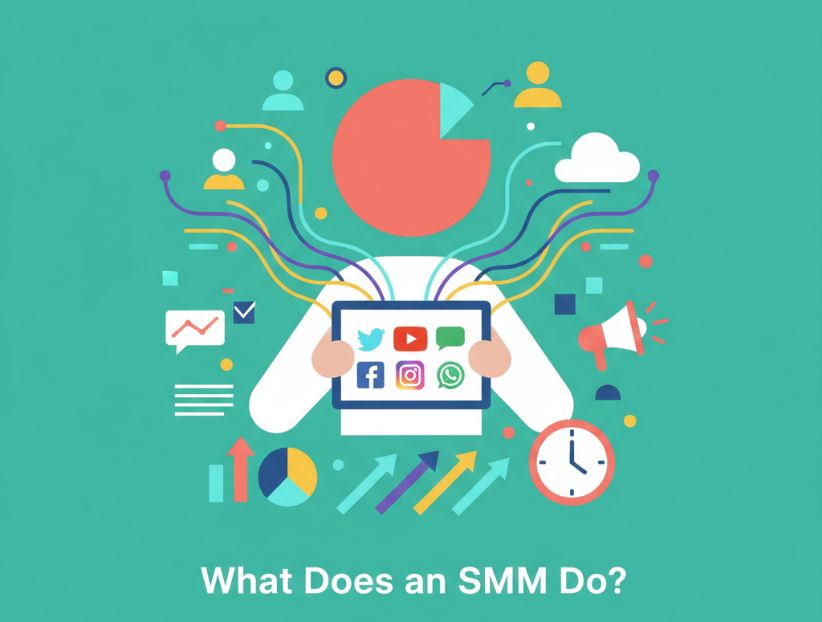
A business publishes every day, but the posts have no clear purpose. Comments go unanswered, trends are copied without checking whether they fit the brand, and nobody can explain which content generated useful results. This is usually the problem an SMM is hired to solve. The phrase What Does a SMM Do? refers mainly to the work of a Social Media Manager, Social Media Marketer, or Social Media Marketing specialist.
An SMM may use scheduling software, analytics dashboards, advertising tools, design platforms, listening tools, or an Instagram panel, but the job is much broader than operating tools. The specialist connects business goals with audience research, content, publishing, community interaction, campaigns, performance data, and continuous improvement.
This guide explains the role from strategy to daily execution. It covers what an SMM plans, creates, publishes, monitors, measures, reports, and improves, along with the difference between an SMM specialist and an SMM panel. It also shows what a competent professional should deliver and which results remain outside their direct control.
What Does a SMM Do?
Direct answer: An SMM plans and manages a brand’s social media activity. The role typically includes setting goals, researching the audience and competitors, building a content strategy, creating or coordinating posts, scheduling publication, managing comments and messages, monitoring brand conversations, supporting paid campaigns, reviewing analytics, reporting results, and improving future activity. An SMM aims to build visibility, relationships, engagement, traffic, leads, or sales, depending on the business objective. The specialist may use an SMM panel for limited service or workflow support, but the panel does not replace strategy, creativity, community management, or performance analysis.
In simple terms, an SMM decides what the brand should say, who it should say it to, where and when it should publish, how it should respond, and how to determine whether the activity worked.
The exact duties change according to company size. In a small business, one person may write captions, edit videos, answer messages, run advertisements, and prepare reports. In a larger company, those responsibilities may be divided among strategists, designers, copywriters, media buyers, analysts, and community managers.
| Main Responsibility | What the SMM Does | Why It Matters |
|---|---|---|
| Strategy | Connects social media activity with business goals. | Prevents random posting without a measurable purpose. |
| Audience research | Studies who the brand needs to reach and what they care about. | Improves message relevance and platform selection. |
| Content planning | Builds topics, formats, campaigns, and publishing schedules. | Creates consistency without repeating the same idea. |
| Publishing | Prepares, schedules, checks, and distributes posts. | Ensures content appears correctly and on time. |
| Community management | Responds to comments, messages, mentions, and audience questions. | Turns one-way posting into an active relationship. |
| Campaign management | Coordinates launches, promotions, collaborations, and paid activity. | Keeps campaign messages and deadlines aligned. |
| Analytics | Measures reach, engagement, traffic, leads, and conversions. | Shows which actions deserve to continue or change. |
| Reporting | Explains performance, problems, lessons, and next steps. | Helps stakeholders make informed decisions. |
What Does SMM Stand For?
SMM stands for Social Media Marketing. It describes the use of social platforms to reach audiences, build relationships, promote products or services, support customer communication, and generate measurable business results.
When someone says “an SMM,” they usually mean a person working in social media marketing, such as a Social Media Manager or Social Media Marketing specialist. Grammatically, “an SMM” is more natural because the abbreviation begins with the vowel sound “ess.”
| Use of the Term | Meaning |
|---|---|
| SMM | The discipline of Social Media Marketing |
| An SMM | A Social Media Manager, marketer, or specialist |
| SMM strategy | The plan used to reach social media objectives |
| SMM campaign | A coordinated set of organic or paid social activities |
| SMM panel | A dashboard for ordering and managing selected social media services |
How Does an SMM Build a Social Media Strategy?
The work begins before content creation. A professional SMM needs to understand the business, audience, offer, competition, resources, and desired outcome before deciding what to publish.
- Clarify the business objective.
- Define the target audience.
- Audit existing accounts and content.
- Review competitors and market conversations.
- Select priority platforms.
- Define content pillars and brand voice.
- Choose measurable KPIs.
- Create a publishing and campaign plan.
- Measure, learn, and adjust.
A useful strategy does not begin with “we need more followers.” It begins with a business need. The business may want stronger awareness in a new market, more qualified website traffic, product education, customer support, event registrations, job applicants, or repeat purchases.
| Business Goal | Possible Social Media Objective | Relevant Measurements |
|---|---|---|
| Increase awareness | Reach more relevant people repeatedly. | Reach, impressions, video views, branded searches |
| Build engagement | Encourage useful audience interaction. | Comments, saves, shares, replies, engagement quality |
| Generate traffic | Move relevant users to the website. | Link clicks, sessions, engaged visits |
| Generate leads | Encourage inquiries or form submissions. | Qualified messages, forms, calls, cost per lead |
| Support sales | Move users closer to a purchase. | Conversions, revenue, assisted sales, return on spend |
| Improve support | Answer questions and resolve issues efficiently. | Response time, resolution rate, recurring issues |
How Does an SMM Research the Audience?
An SMM needs to know more than the audience’s age or location. Useful research looks at needs, motivations, language, objections, preferred formats, platform behavior, buying stage, and the questions people ask before taking action.
- Who needs the product or information?
- Which problems are they trying to solve?
- What prevents them from trusting or buying?
- Which social platforms do they use?
- What content do they save, share, or discuss?
- Which words do they use to describe the problem?
- What action should they take after viewing the content?
Audience research can include platform insights, customer interviews, sales questions, support tickets, website searches, comments, reviews, competitor communities, and recurring objections. The SMM then converts those findings into content ideas and campaign decisions.
What Content Does an SMM Create?
Content responsibility depends on the role. Some SMMs produce everything themselves, while others write briefs and coordinate designers, editors, photographers, presenters, or copywriters.
| Content Type | Possible SMM Responsibility |
|---|---|
| Short-form video | Research topic, write hook, prepare script, coordinate recording, review edit, publish |
| Image or carousel post | Choose concept, prepare copy, brief designer, check layout, write caption |
| Stories | Plan interactive frames, questions, polls, links, offers, and behind-the-scenes updates |
| Long-form post | Turn expertise, research, or customer stories into structured educational content |
| Community content | Highlight customers, testimonials, user-generated posts, or audience contributions |
| Promotional content | Present the offer, value, evidence, deadline, and call to action clearly |
| Campaign assets | Coordinate launch posts, reminders, ads, landing-page messages, and follow-up content |
A strong SMM balances promotional content with education, entertainment, trust-building, conversation, proof, and community value. Publishing only sales messages usually gives audiences little reason to remain interested.
How Does an SMM Plan a Content Calendar?
A content calendar organizes what will be published, where it will appear, who will create it, when approval is required, and which objective it supports.
| Calendar Field | Purpose |
|---|---|
| Publication date | Keeps deadlines and campaign timing visible. |
| Platform | Prevents identical content from being copied everywhere without adaptation. |
| Content pillar | Maintains a balanced mix of topics. |
| Format | Identifies video, carousel, Story, text, live content, or another format. |
| Objective | Connects the post to awareness, engagement, traffic, lead, or sales goals. |
| Owner | Clarifies who writes, designs, approves, and publishes. |
| Status | Shows whether the item is an idea, draft, review, approved, scheduled, or published. |
| Result | Records performance and lessons for later planning. |
The calendar provides structure without making the strategy rigid. An SMM should still leave room for customer questions, timely trends, platform changes, news, and unexpected campaign opportunities.
Does an SMM Publish and Schedule Posts?
Yes, publishing and scheduling are common duties. The SMM checks captions, links, tags, creative files, formatting, accessibility, timing, campaign alignment, and approval before content becomes public.
Scheduling is not merely pressing a button. Platform-specific details can change the result. A caption that works on LinkedIn may feel unnatural on TikTok, while a horizontal video designed for YouTube may need a different edit for Instagram Reels.
- Confirm the correct account and platform.
- Review the final creative and caption.
- Test links and tracking parameters.
- Check tags, mentions, collaborators, and product labels.
- Add subtitles, alternative text, or accessibility details where available.
- Verify the publication date and time zone.
- Review the post after it becomes public.
- Correct formatting problems quickly.
How Does an SMM Manage the Community?
Community management is the relationship side of the role. The SMM responds to comments, questions, mentions, direct messages, feedback, complaints, and user-generated content according to the brand’s voice and escalation rules.
| Audience Interaction | SMM Action |
|---|---|
| Product question | Provide accurate information or direct the user to the right resource. |
| Customer complaint | Acknowledge the issue, gather details, and escalate when necessary. |
| Positive feedback | Respond naturally and strengthen the relationship. |
| Spam or abuse | Moderate according to published community rules. |
| Useful user content | Request permission and consider reposting or featuring it. |
| Recurring question | Turn the question into a future post, FAQ, or support resource. |
A good SMM does not treat every reply as a sales opportunity. Helpful answers, honest limitations, and consistent communication often create more trust than aggressive promotion.
Does an SMM Monitor Brand Reputation?
Yes. Social listening and reputation monitoring help the brand understand what people are saying even when they do not tag the official account directly.
- Brand-name mentions and misspellings
- Product reviews and customer complaints
- Competitor conversations
- Industry trends and emerging topics
- Frequently repeated questions
- Potential misinformation or reputation issues
- Opportunities to join relevant conversations
Not every negative comment is a crisis. The SMM assesses reach, accuracy, seriousness, customer impact, and response risk before deciding whether to reply publicly, move the discussion privately, escalate internally, or monitor without reacting.
Does an SMM Run Paid Social Campaigns?
Sometimes. In smaller teams, the SMM may manage paid campaigns directly. Larger organizations often have a dedicated paid-media specialist who works with the organic social team.
| Paid Campaign Task | Possible SMM Role |
|---|---|
| Campaign objective | Define awareness, traffic, lead, sales, or retargeting goals. |
| Audience | Build or recommend target segments. |
| Creative | Coordinate ad copy, video, image, and landing-page consistency. |
| Budget | Allocate spending according to the campaign plan. |
| Testing | Compare hooks, formats, audiences, and calls to action. |
| Optimization | Reduce weak spending and increase investment in stronger combinations. |
| Reporting | Explain cost, reach, leads, conversions, and lessons. |
Organic posting and paid advertising support each other, but they are not identical. Paid campaigns buy distribution through the platform’s advertising system, while organic content depends more heavily on audience choice and platform recommendations.
How Does an SMM Measure Performance?
An SMM measures progress according to the original objective. A large number of impressions may be useful for awareness but insufficient evidence for a lead-generation campaign.
Official Meta Business Suite Insights can help businesses review results from organic and paid Facebook and Instagram activity. Platform data should be combined with website analytics, CRM records, sales information, and customer feedback when business outcomes matter.
| Metric | What It Helps Measure | Common Misinterpretation |
|---|---|---|
| Reach | How many accounts may have seen the content | Assuming every reached user noticed or remembered it |
| Impressions | How many times content was displayed | Treating repeated displays as unique people |
| Engagement | Likes, comments, saves, shares, clicks, or other actions | Treating every interaction as equally valuable |
| Watch time | How long users remained with video content | Looking only at the public view count |
| Profile visits | Whether content encouraged deeper interest | Assuming every visitor became a follower or customer |
| Link clicks | Traffic generated from social content | Ignoring website quality and conversion behavior |
| Conversions | Leads, registrations, purchases, or other key actions | Giving social media full credit without attribution review |
What Does an SMM Report to the Business?
A useful report explains what happened, why it may have happened, what was learned, and what should change next. It should not be a collection of screenshots without interpretation.
- Objectives and reporting period
- Content and campaigns published
- Performance compared with the previous period
- Best- and worst-performing content
- Audience and community observations
- Website, lead, or sales outcomes where available
- Advertising costs and results
- Problems, limitations, and unusual events
- Recommended experiments and next actions
The SMM should avoid presenting correlation as certainty. A sales increase after a popular post does not automatically prove the post caused every purchase. Strong reporting makes assumptions visible and distinguishes confirmed data from interpretation.
What Does an SMM Do Each Day?
Daily work usually combines planned tasks with real-time communication. The exact schedule changes according to the number of accounts, platforms, campaigns, and team members.
| Daily Activity | Example |
|---|---|
| Account check | Review notifications, comments, messages, mentions, and publishing errors. |
| Community responses | Answer questions and escalate customer issues. |
| Publishing review | Confirm scheduled posts are correct and live. |
| Performance monitoring | Watch active campaigns and unusual changes. |
| Content production | Write, edit, brief, review, or approve upcoming material. |
| Internal coordination | Collect information from product, sales, support, or leadership teams. |
| Trend review | Identify relevant opportunities without copying every popular format. |
What Does an SMM Do Weekly and Monthly?
| Frequency | Common Responsibilities |
|---|---|
| Weekly | Review recent content, adjust the calendar, prepare upcoming posts, meet the team, analyze community questions, and check campaign pacing. |
| Monthly | Prepare a performance report, review KPIs, identify patterns, update the strategy, plan campaigns, and recommend budget or content changes. |
| Quarterly | Reassess platforms, audience priorities, resource needs, competitive position, larger campaigns, and business alignment. |
A competent SMM does not wait until the end of the month to discover that a campaign failed. Daily and weekly monitoring allows smaller adjustments before the budget or opportunity is lost.
What Is the Difference Between an SMM and a Community Manager?
The roles often overlap, particularly in small teams. The main difference is usually scope: the SMM manages the broader strategy and performance, while the community manager focuses more heavily on audience relationships and daily interaction.
| Role | Primary Focus |
|---|---|
| Social Media Manager | Strategy, planning, publishing, campaigns, coordination, and performance |
| Community Manager | Comments, messages, community health, relationships, moderation, and feedback |
| Content Creator | Producing videos, images, writing, photography, or other creative assets |
| Social Media Strategist | Research, positioning, goals, platform choices, and long-term direction |
| Paid Media Specialist | Advertising setup, targeting, budget, testing, and optimization |
| Social Media Analyst | Data collection, dashboards, attribution, and performance interpretation |
Before hiring, the business should define which of these responsibilities are included. The title alone does not tell you whether the person will film content, answer support questions, run ads, or work only on strategy.
What Is the Difference Between an SMM and an SMM Panel?
An SMM is a person or marketing function. An SMM panel is a software dashboard used to order and manage selected social media services.
The beginner explanation of what an SMM panel is shows that the panel normally handles balances, service selection, public links, quantities, Order IDs, statuses, and support records. It does not independently create a complete marketing strategy.
| Capability | SMM Specialist | SMM Panel |
|---|---|---|
| Understand the business | Yes | No |
| Research the audience | Yes | No |
| Build content strategy | Yes | No |
| Create or coordinate content | Often | No |
| Manage comments and messages | Often | No |
| Order selected social media services | May use the tool | Yes |
| Track service Order IDs | May review them | Yes |
| Interpret business results | Yes | No |
How Might an SMM Use a Panel?
Some social media managers, agencies, or resellers use panels for limited operational purposes, such as testing selected services, managing several service categories through one dashboard, or tracking repeat orders.
Before using one, the specialist should review the available social media services, required links, minimum quantities, expected timing, refill conditions, and platform-specific limitations.
| Possible Panel Use | What It May Support | What It Cannot Guarantee |
|---|---|---|
| Visible metric testing | A controlled change in followers, likes, views, or another listed metric | Genuine interest or future engagement |
| Campaign presentation | Selected visible activity around a post or profile | Organic recommendations or virality |
| Agency workflow | Centralized balances, orders, statuses, and support tickets | Client satisfaction or campaign success |
| Reseller operations | Wholesale access and repeat service management | Profit after refunds, fees, and support costs |
The operational explanation of how the platform works should be understood before the tool is added to a client or brand workflow.
What Can an SMM Panel Not Replace?
- Audience research and positioning
- Useful content and creative judgment
- Brand voice and reputation management
- Customer conversations and support
- Offer quality and product-market fit
- Paid advertising strategy
- Website and conversion optimization
- Accurate analytics interpretation
- Long-term trust and community development
The practical service limitations matter because ordered metrics cannot guarantee sales, loyal followers, ranking, monetization, viral distribution, or complete account safety.
What Skills Does a Good SMM Need?
| Skill | How It Appears in the Work |
|---|---|
| Strategic thinking | Connects daily content with business priorities. |
| Writing | Creates clear hooks, captions, scripts, replies, and reports. |
| Visual judgment | Recognizes whether creative work is clear, suitable, and on-brand. |
| Communication | Coordinates teams and responds appropriately to audiences. |
| Data analysis | Turns metrics into decisions rather than simply listing numbers. |
| Organization | Manages calendars, deadlines, approvals, files, and campaigns. |
| Platform awareness | Understands format, audience, policy, and feature differences. |
| Customer understanding | Recognizes needs, objections, questions, and buying stages. |
| Adaptability | Responds to changing performance without chasing every trend. |
| Risk judgment | Knows when not to publish, respond, advertise, or use a third-party tool. |
What Should an SMM Deliver?
The business should receive visible work and documented decisions. “Managing social media” is too vague to evaluate without agreed deliverables.
- Social media audit or starting assessment
- Goals, audience definition, and platform priorities
- Content pillars and brand-voice guidance
- Monthly or campaign content calendar
- Captions, scripts, briefs, or completed creative assets
- Publishing and community-management plan
- Campaign setup and tracking where included
- Performance report with interpretation
- Recommended next steps
The scope should also state how many platforms, posts, Stories, videos, replies, meetings, revisions, and reports are included. This prevents disagreement over tasks that were never part of the original service.
How Can You Evaluate Whether an SMM Is Doing a Good Job?
| Evaluation Area | Positive Signal | Warning Sign |
|---|---|---|
| Strategy | Every activity connects to a stated objective. | Posting decisions are random or trend-driven. |
| Content | Topics address real audience needs and brand priorities. | Content is generic, repetitive, or copied. |
| Consistency | Deadlines and quality standards are usually maintained. | Posts are frequently missed without explanation. |
| Community | Questions and issues receive appropriate responses. | Comments and messages are ignored. |
| Data | Reports connect metrics with decisions. | Only follower or like counts are presented. |
| Learning | The plan changes when evidence supports a better approach. | The same weak activity continues without review. |
| Communication | Problems, limitations, and needs are explained early. | Unrealistic promises replace transparent updates. |
What Results Can an SMM Realistically Influence?
An SMM can influence the quality, consistency, relevance, distribution, and measurement of social media activity. The specialist cannot directly control every audience or platform decision.
| More Directly Influenced | Not Fully Controlled |
|---|---|
| Quality and clarity of the strategy | Whether content becomes viral |
| Content relevance and production | Platform recommendation decisions |
| Publishing consistency | Every user’s reaction |
| Response quality and speed | Public sentiment outside the brand’s control |
| Campaign structure and testing | Guaranteed leads or sales |
| Measurement and reporting quality | Market demand or product quality |
What Should an SMM Not Do?
- Promise guaranteed virality, sales, or follower growth.
- Publish sensitive content without approval.
- Ignore platform policies or brand-risk concerns.
- Buy unclear services without understanding their limits.
- Present purchased metrics as organic customer interest.
- Hide weak results or manipulate reports.
- Use customer data for unrelated purposes.
- Copy competitors without adapting the idea.
- Respond emotionally during a reputation issue.
- Measure success only by follower count.
When Is an SMM Panel Useful to a Specialist?
A panel may be useful when the specialist has a specific, limited objective and can separate the ordered metric from organic performance. It may also simplify service ordering for agencies or resellers that need centralized records.
The broader benefits of using an SMM panel relate mainly to convenience, transparent service lists, balances, Order IDs, status tracking, and support workflows.
Those operational benefits are only useful when the service fits the campaign and the SMM understands how to measure the result. A panel order should not be used to hide weak content, mislead a client, or replace genuine audience development.
How Should an SMM Use a Panel Responsibly?
- Define the exact objective. Know why the service is being considered.
- Review the account and platform context. Do not assume one service fits every profile.
- Read the service description. Check link type, quantity, timing, refill, and limitations.
- Use a small test. Verify the service before applying it to an important campaign.
- Record the baseline. Separate purchased delivery from organic activity.
- Track the Order ID. Keep financial and delivery records.
- Review the final result. Compare delivery with the status and service conditions.
- Measure wider outcomes separately. Look at real engagement, traffic, leads, or sales.
- Stop when the service creates more confusion than value.
The practical guide on how to use an SMM panel correctly explains the ordering process, correct-link requirements, small test approach, status tracking, and post-delivery checks.
What Happens After an SMM Panel Order?
After delivery, the SMM should verify the count, order status, remains, retention, and any measurable campaign effect. A Completed status alone does not prove the campaign objective was achieved.
The dedicated guide to what happens after delivery helps separate immediate service completion from later evaluation, refill eligibility, support review, and strategic value.
| Post-Delivery Check | Question |
|---|---|
| Delivery | Did the visible quantity match the order status? |
| Timing | Did the service begin and finish near the stated range? |
| Retention | How much of the delivered metric remained? |
| Support | Were Partial, Failed, or refill cases handled clearly? |
| Organic response | Did genuine saves, shares, replies, or profile actions change? |
| Business response | Did qualified traffic, leads, sales, or another useful outcome improve? |
What Questions Should You Ask Before Hiring an SMM?
- Which platforms and responsibilities are included?
- Will you create content or only manage publishing?
- Who writes, designs, films, and approves the content?
- Are community management and customer replies included?
- Will you manage paid advertisements?
- Which goals and KPIs will be used?
- How frequently will you report?
- How will you access and protect our accounts?
- Do you use third-party services or SMM panels?
- How do you separate purchased metrics from organic results?
- What information and resources do you need from us?
- What outcomes will you not guarantee?
The answer should reveal a clear process rather than a promise of instant followers. A capable professional will normally ask questions about the business, customer, offer, resources, previous results, and internal approval process before recommending tactics.
What Is the Final Answer to What Does a SMM Do?
What Does a SMM Do? An SMM manages the connection between a brand, its social platforms, and its audience. The role combines strategy, audience research, content planning, publishing, community management, campaigns, social listening, analytics, reporting, and continuous improvement.
The specialist may create content directly or coordinate other professionals. They may also manage paid campaigns, customer conversations, creator partnerships, and selected third-party tools depending on the agreed scope.
An SMM panel can support limited ordering and workflow tasks, but it cannot replace the professional’s judgment. Real social media growth still depends on useful content, audience relevance, trust, communication, a strong offer, and measurable business strategy.
The clearest answer is that an SMM turns social media from random posting into a planned, managed, and measurable marketing process.
Frequently Asked Questions
Is an SMM the same as a social media manager?
The term “an SMM” commonly refers to a Social Media Manager or Social Media Marketing specialist. Exact responsibilities depend on the company and job description.
Some SMMs manage strategy and reporting, while others also create content, answer messages, run advertisements, and coordinate campaigns.
Does an SMM create all social media content?
Sometimes. In a small business, the SMM may write, design, film, edit, schedule, and publish most content personally.
In a larger team, the SMM may create briefs and coordinate copywriters, designers, videographers, editors, and subject-matter experts.
Can an SMM guarantee followers, sales, or viral content?
No professional can guarantee audience behavior, platform recommendations, sales, or virality. Those outcomes depend on many factors beyond one person’s control.
A capable SMM can guarantee a defined process, consistent execution, clear measurement, honest reporting, and evidence-based improvement.
Does an SMM use an SMM panel?
Some specialists or agencies may use a panel for limited service testing, visibility support, reseller operations, or centralized order management.
The panel remains a tool and cannot replace content strategy, audience research, community management, advertising judgment, or analytics.
How do I know whether an SMM is doing useful work?
Review whether the specialist has clear objectives, a documented plan, relevant content, consistent execution, appropriate community responses, and reports connected to meaningful KPIs.
Useful work should create learning and progress toward business goals rather than only increasing surface-level follower, like, or view counts.